Disclosure: We may earn a commission if you buy through links on this page — at no extra cost to you. Learn more.
Statements on this site have not been evaluated by the Food and Drug Administration.
Products and information are not intended to diagnose, treat, cure, or prevent any disease. Learn More
Products and information are not intended to diagnose, treat, cure, or prevent any disease. Learn More
Summary
Rhodiola rosea is an adaptogenic herb used for stress resilience, energy, and cognitive performance under fatigue. In adults facing mental or physical stress, standardized extracts have shown modest improvements in fatigue, mood, and attention with a favorable short‑term safety profile.
Our Picks
Rhodiola — Thorne
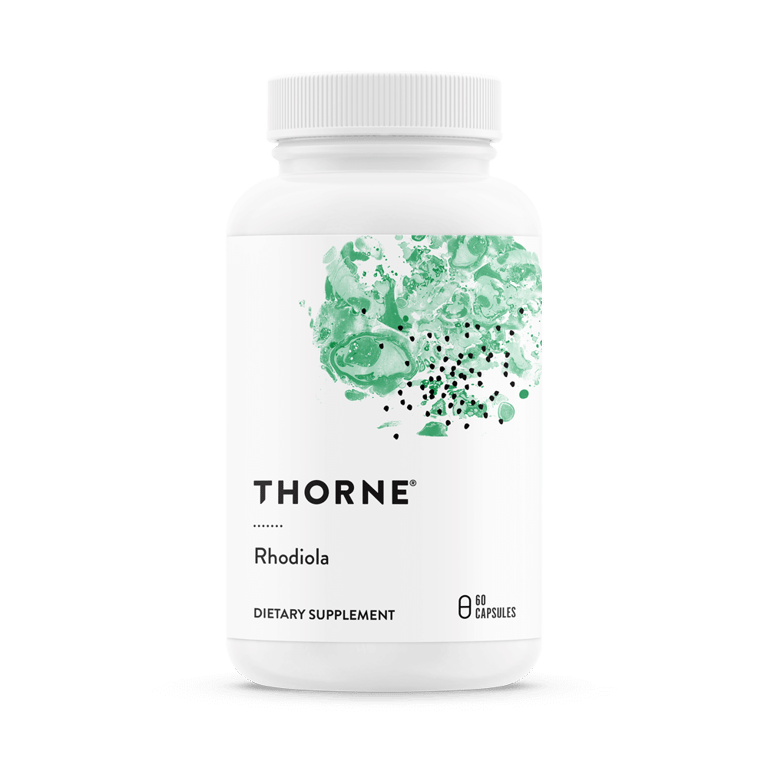
A stress-relieving botanical that supports neurotransmitters to enhance mood, sleep, and mental focus. NSF Certified for Sport®.
Mental Clarity, Focus, and Energy
- RCTs and pragmatic trials suggest reduced fatigue and improved attention and processing speed during stress, shift work, or demanding tasks.
- Effects often emerge within 1–2 weeks, with some acute benefits reported within hours in sensitive individuals.
- Magnitude is modest; largest effects occur in participants with higher baseline stress or fatigue.
- Heterogeneity: extract standardization, dose (typically 200–400 mg/day), and study quality vary widely.
Brain Health
- Mechanisms: modulation of HPA‑axis stress responses, mitochondrial support, antioxidant activity, and monoamine signaling.
- Limited evidence for disease modification; current support centers on stress, fatigue, and mood parameters rather than long‑term neuroprotection.
Gut Health
- Generally well tolerated at standard doses. Mild GI upset may occur; take with food if sensitive.
- Direct human data on microbiome or barrier integrity are limited.
Brain-Gut Axis
- By attenuating stress responses and perceived fatigue, rhodiola may indirectly improve gut–brain communication in stress‑exacerbated GI symptoms. Evidence is plausible but not definitive.
Evidence Summary
Benefit Area | Evidence Quality | Effect Noted | Notes |
Mental Clarity | Moderate | Improved attention under stress | Standardized extracts; 200–400 mg/day |
Focus Enhancement | Moderate | Faster processing speed during fatigue | Effects within 1–2 weeks |
Energy Support | Moderate | Reduced perceived fatigue | Greatest in high‑stress cohorts |
Brain Health | Limited | Mechanistic antioxidant and HPA modulation | Few long‑term trials |
Gut Health | Limited | Mild GI effects possible | Take with food if sensitive |
Brain–Gut Optimization | Emerging | Stress reduction may aid gut symptoms | Indirect evidence |
Typical Dosing Instructions
- Standard dose: 200–400 mg/day of a standardized extract (e.g., 3% rosavins, 1% salidroside)
- Timing: Morning or early afternoon to avoid insomnia; with food if GI sensitive
- Form: SHR‑5 or WS 1375 standardized extracts have the most study use
- Notes: Trial for 2–8 weeks; consider cycling if tolerance develops
Safety Considerations
- General safety: Well tolerated at typical doses; transient jitteriness or insomnia can occur, especially if dosed late
- Common effects: Reduced fatigue, improved stress tolerance; occasional GI upset
- Contraindications and cautions: Possible interactions with antidepressants, stimulants, MAOIs, and SSRIs; avoid use in bipolar disorder without clinician oversight
- Populations: Limited data in pregnancy or pediatrics; avoid unless clinician‑directed
- Monitoring: Track sleep latency, anxiety, and task performance; reduce dose or move earlier in the day if overstimulation occurs
References
- Rhodiola rosea in stress‑induced fatigue: double‑blind, placebo‑controlled cross‑over with standardized extract SHR‑5 during night duty, Phytomedicine, 2000-01-01
- A randomized, double‑blind, placebo‑controlled, parallel‑group study of standardized extract SHR‑5 for stress‑related fatigue1, Planta Medica, 2009-02-01
- Rhodiola rosea for mental and physical fatigue in nursing students: randomized controlled trial, PLoS One, 2014-09-30
- Rhodiola rosea for physical and mental fatigue: a systematic review, BMC Complementary and Alternative Medicine, 2012-05-29
- Rhodiola rosea as an adaptogen to enhance exercise performance: a review, British Journal of Nutrition, 2023-08-29
- Clinical trial of Rhodiola rosea extract SHR‑5 in mild to moderate depression, Nordic Journal of Psychiatry, 2007-01-01