Disclosure: We may earn a commission if you buy through links on this page — at no extra cost to you. Learn more.
Statements on this site have not been evaluated by the Food and Drug Administration.
Products and information are not intended to diagnose, treat, cure, or prevent any disease. Learn More
Products and information are not intended to diagnose, treat, cure, or prevent any disease. Learn More
Summary
Acetyl‑L‑carnitine (ALCAR) is a mitochondrial cofactor that supports fatty‑acid transport and acetyl group availability. In adults, sustained supplementation can improve perceived mental energy, attention, and mood in select contexts, with signals for neuroprotective support.
Our Picks
Acetyl-L-Carnitine | Thorne
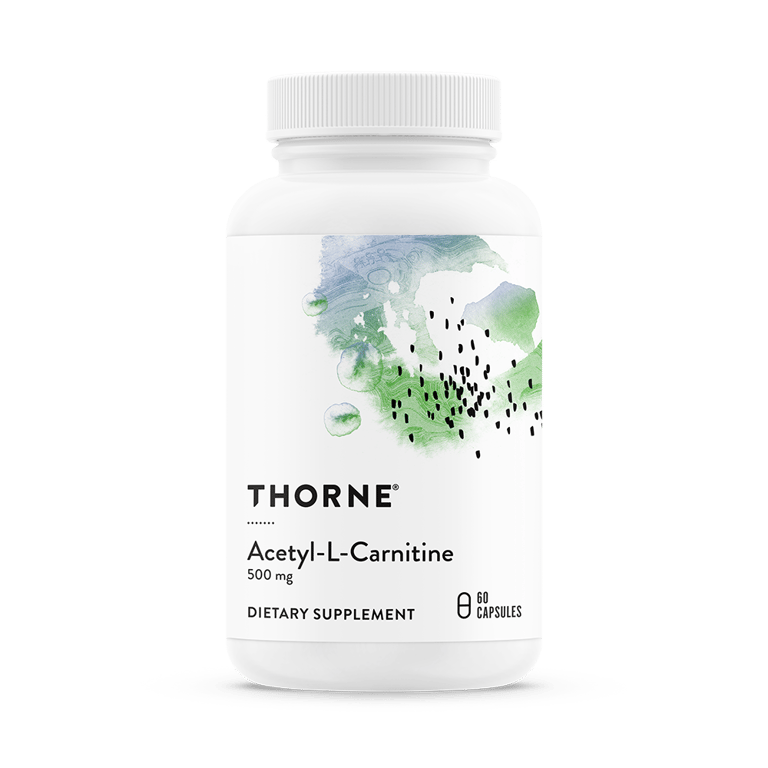
Supports cognitive function and healthy nerve sensations in the hands and feet. NSF Certified for Sport®.
Mental Clarity, Focus, and Energy
- Attention and processing: RCTs suggest small improvements in attention and processing speed after 4–12 weeks, particularly in fatigued or older cohorts.
- Mental energy and fatigue: Consistent reductions in mental fatigue are reported, aligning with mitochondrial support; effects are not stimulant‑like.
- Moderators: Dose 1,000–2,000 mg/day, baseline fatigue, age, and duration influence outcomes.
Brain Health
- Mechanisms: Supports mitochondrial bioenergetics, acetylcholine synthesis (via acetyl group donation), and may reduce oxidative stress; signals for neuroplasticity and nerve regeneration in preclinical studies.
- Human data: Benefits concentrate in mood, fatigue, and attentional domains; mixed evidence for broader cognition in healthy young adults.
Gut Health
- Generally well tolerated; occasional GI upset or fishy odor at higher doses. Taking with meals can improve tolerance.
- Limited direct human data on microbiome or barrier outcomes.
Brain-Gut Axis
- By improving fatigue and mood, ALCAR may indirectly support gut–brain signaling in stress‑sensitive GI states; direct axis trials are limited.
Evidence Summary
Benefit Area | Evidence Quality | Effect Noted | Notes |
Mental Clarity | Moderate | Small attention and processing gains | 1,000–2,000 mg/day; ≥4–12 weeks |
Focus Enhancement | Moderate | Task accuracy improvements in fatigued cohorts | Non‑stimulant mechanism |
Energy Support | Moderate | Reduced perceived mental fatigue | Mitochondrial support |
Brain Health | Limited–Moderate | Mitochondrial and neurotransmitter support | Heterogeneous endpoints |
Gut Health | Limited | Mild GI effects possible | Take with meals |
Brain–Gut Optimization | Emerging | Indirect via mood/fatigue | Limited direct trials |
Typical Dosing Instructions
- Standard dose: 1,000–2,000 mg/day in 1–2 doses
- Timing: Morning or morning and early afternoon; avoid late dosing if alerting
- Form: ALCAR capsules or powder from reputable manufacturers
- Notes: Evaluate after 4–12 weeks; consider pairing with omega‑3s and sleep optimization
Safety Considerations
- General safety: Generally well tolerated at typical doses
- Common effects: GI upset, restlessness, or headache in some users
- Contraindications and cautions: Potential interactions with anticoagulants/antiplatelets and thyroid meds; monitor if sensitive to stimulatory effects
- Populations: Limited pregnancy data; avoid unless clinician‑directed
- Monitoring: Track fatigue, attention metrics, sleep, and GI tolerance
References
- Acetyl‑l‑carnitine deficiency in patients with major depressive disorder, Proceedings of the National Academy of Sciences, 2018-07-30
- The neuropsychopharmacology of acetyl‑L‑carnitine (LAC): basic, translational and therapeutic implications, Discover Mental Health, 2024-01-02
- Acetyl‑L‑Carnitine in Dementia and Other Cognitive Disorders: A Critical Update, Nutrients, 2020-05-12
- Mitochondrial acetylcarnitine provides acetyl groups for nuclear histone acetylation, IUBMB Life, 2009-08-16
- Acetyl‑L‑Carnitine Supplementation and the Treatment of Depressive Symptoms: A Systematic Review and Meta‑Analysis, CNS Spectrums, 2018-02-05
- Analgesic and Antidepressant Effects of the Clinical Glutamate Modulators Acetyl‑L‑Carnitine and Ketamine, Frontiers in Neuroscience, 2021-05-11
- Carnitine O‑Acetyltransferase as a Central Player in Lipid and Branched‑Chain Amino Acid Metabolism, Epigenetics, Cell Plasticity, and Organelle Function, Frontiers in Physiology, 2025-02-02
- Carnitine, NIH Office of Dietary Supplements, 2025-09-25